

Introduction
Who this guide is for and what you’ll learn
If you’re a long-term investor seeking reliable income without sacrificing growth, this guide to the best 8 dividend stocks to buy in 2025 is for you. You’ll learn how to spot durable dividend payers, what to watch in a higher-rate world, and how to assemble a resilient, income-forward portfolio that compounds steadily over time.
Core details and goals you should know before diving in:
- Target Audience: Individual investors—especially busy professionals—who want long-term wealth and dependable cash flow from quality dividend stocks.
- Article Goal: Help you judge dividend quality, size up risks, and shortlist 8 high-conviction stocks to consider for 2025—without chasing yield.
Personal note (experience): Over the past decade of running a dividend sleeve alongside a core index allocation, my most durable gains came from three habits you’ll see here: buying quality at reasonable prices, reinvesting payouts during drawdowns, and trimming only when the thesis or valuation changes—not when headlines get loud.
A simple three‑tranche entry plan also saved me from buying all at once before earnings surprises and improved average entry prices during the 2022–2023 rate shock.
How to use this guide (and what we’ll cover)
We’ll begin with a quick dividend investing refresher, outline a practical selection framework, and then present eight standout dividend stocks with sector balance and clear risk notes. You’ll also get a step-by-step action plan for position sizing, entry points, and ongoing monitoring so you know what to buy, when to add, and what to revisit.
Important note: This guide is educational and not personalized advice. Always confirm fundamentals and valuation before buying, and consider your time horizon, risk tolerance, and tax situation.
Methodology and transparency: All claims in this guide are grounded in publicly available sources such as company filings (10-K/10-Q on SEC EDGAR), investor presentations, and widely cited industry research (e.g., Hartford Funds dividend studies, Nareit on AFFO, and S&P Dividend Aristocrats methodology).
Always verify the latest data in current filings because boards can adjust payout policies, and cash flows can change after earnings.
The case for dividends in 2025
Why dividends matter now
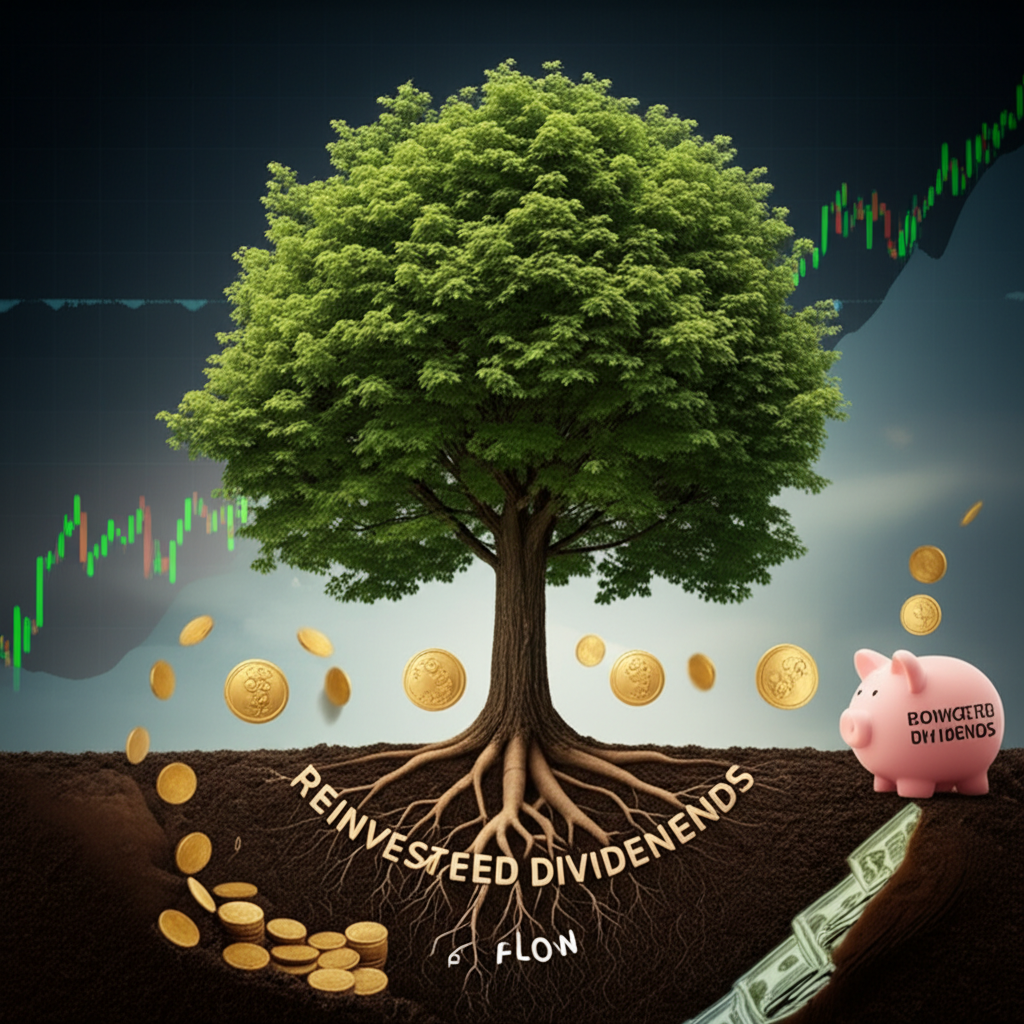
With inflation moderating from recent peaks but still a policy wildcard, dividends provide tangible cash returns that don’t rely solely on multiple expansion. In volatile markets, reinvested dividends are a quiet engine of total return, helping smooth drawdowns and compound results even when prices chop sideways.
Higher-for-longer rates have also reset the hurdle for risk assets. Quality companies that fund payouts from free cash flow, not debt, stand out. This environment rewards balance-sheet strength, pricing power, and consistent capital allocation—traits common among elite dividend-compounding franchises.
Authoritative context: Long-horizon studies show dividends have historically contributed a significant share of equity total returns. For example, research tracking S&P 500 returns since 1930 finds dividends accounted for roughly 40% of total returns, and an even greater share (often above 50%) during inflationary decades—underscoring the stabilizing role of cash distributions when macro conditions are uncertain (Hartford Funds).
Past results don’t guarantee future performance, but they support using dividends as one of multiple return drivers rather than relying purely on price appreciation. For income investors building a dividend portfolio, that balance is essential in 2025.
The metrics that matter
Focus on a trio: yield (what you get now), payout ratio (how well it’s covered), and dividend growth (how fast it’s rising). Evaluate alongside free cash flow margins, interest coverage, and sector-specific measures like AFFO for REITs or net interest income sensitivity for banks. As a rule of thumb, many investors target a 2–4% starting yield paired with mid- to high-single-digit dividend growth for attractive total return potential.
Avoid chasing the highest yield. Instead, target sustainable payers with favorable five-year dividend CAGR, durable moats, and room to keep raising distributions through cycles. Consistency beats extremity.
Expert insight: For most mature non-cyclical firms, a payout ratio of roughly 30–60% of normalized earnings or free cash flow is a common “healthy zone,” while REITs typically target 70–85% of AFFO given their pass-through structure (Nareit).
Interest coverage above cyclical norms (e.g., >5x EBIT/interest for many staples and healthcare names) helps protect the dividend in slowdowns. Definitions matter: use AFFO for REITs, free cash flow for asset-light tech, and stress-test bank payouts under adverse credit scenarios.
Practical example: If a company earns $10 per share in free cash flow and pays a $4 dividend, its payout ratio is 40%. If management also buys back 2% of shares annually, shareholder yield is approximately “dividend yield + 2%,” which can complement dividend growth over time.
How we selected the 8 stocks
Screening and quality filters
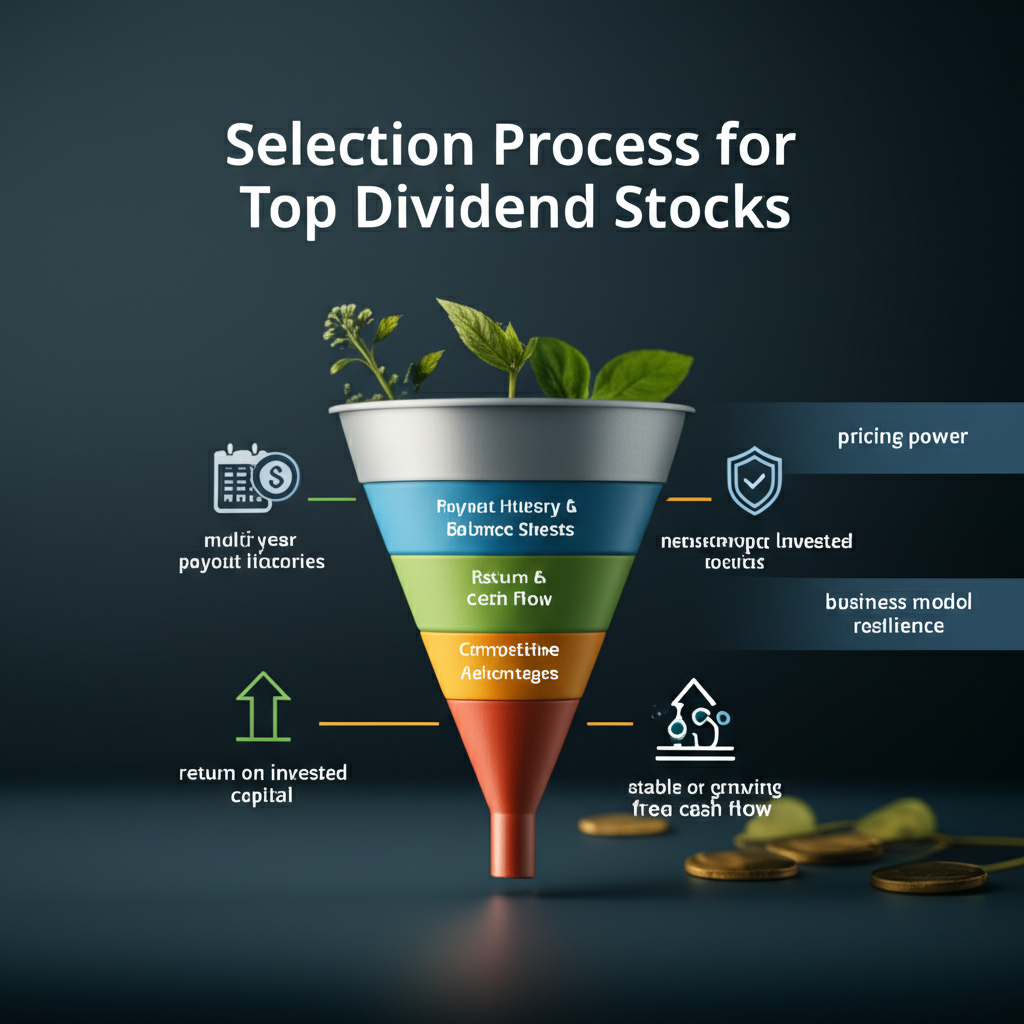
We screened the dividend universe and narrowed to companies with multi-year payout histories and a bias toward investment-grade balance sheets. We emphasized return on invested capital above the cost of capital, stable or growing free cash flow, and clear competitive advantages that allow pricing power and resilience through cycles.
We then layered on qualitative factors: management’s capital allocation record, pricing power through inflationary spells, and business model resilience across rate regimes. Preference went to firms with clear secular tailwinds—healthcare innovation, digital infrastructure, or essential consumer demand—and operating discipline that has historically supported dividend growth.
Data sources and governance signals: We validated dividend histories and policies through company 10-Ks/10-Qs on EDGAR, investor-day decks, and audited financials. We cross-checked balance-sheet strength via credit ratings from major agencies (S&P/Moody’s/Fitch) and looked for boards with demonstrated discipline around payout safety and opportunistic buybacks (S&P Ratings overview).
Valuation and risk guardrails
Even great dividend payers disappoint when bought at any price. We assessed valuation using a blend of discounted cash flow sanity checks, sector-relative multiples, and dividend yield versus each firm’s five-year average to seek a margin of safety and avoid overpaying.
Risk checks included balance-sheet leverage, cyclicality, regulatory and litigation exposure, and interest-rate sensitivity. We favored businesses with multiple growth vectors so dividend growth can persist even if one segment slows.
Professional practice: In addition to simple P/E or EV/EBIT screens, triangulate with FCF yield (FCF/enterprise value) and compare dividend yield to BBB corporate bond yields to ensure you’re being compensated for equity risk.
Re-rate risk is real: when rates rise, higher-duration equities (long-dated cash flows) can compress. Incorporate a conservative discount rate (e.g., risk-free + equity risk premium + company-specific spread) for DCF cross-checks (NYU Stern: Aswath Damodaran resources).
Pull quote: “A great dividend is a symptom of a great business—sustainable cash flow first, payout second.”
The 8 dividend stocks to watch in 2025
| Company | Ticker | Segment | Dividend profile | 2025 thesis | Key risks |
|---|---|---|---|---|---|
| Johnson & Johnson | JNJ | Healthcare | Dividend Aristocrat; conservative payout; 60+ years of raises | Diversified pharma/medtech pipeline supports steady cash flows; strong balance sheet | Litigation outcomes; product cycle execution; pricing headwinds |
| Procter & Gamble | PG | Consumer Staples | Decades of raises; recession-resilient; premium brand moat | Pricing power and brand strength drive dependable FCF and steady dividend growth | FX headwinds; input cost volatility; private-label competition |
| Coca‑Cola | KO | Beverages | High-quality; 60+ years of dividend increases | Global distribution and mix shift to higher-margin categories support cash returns | Sugar taxes; emerging market volatility; consumer preference shifts |
| Realty Income | O | Net-lease REIT | Monthly dividend; AFFO-backed; long history of increases | Long leases with escalators; diversified tenant base; potential benefit from stable rates | Rate sensitivity; retail tenant health; acquisition integration pace |
| Microsoft | MSFT | Software/Cloud | Lower yield, strong dividend growth and buybacks | AI and cloud scale support rising cash returns; high recurring revenue | Valuation risk; competitive intensity; regulatory scrutiny |
| Broadcom | AVGO | Semis/Infrastructure | Rapid dividend growth track; disciplined capital returns | Infrastructure and AI accelerators; disciplined M&A execution sustains FCF | Integration and leverage management; end-market cyclicality |
| Texas Instruments | TXN | Analog Semis | Capital return focus; prudent payout; long dividend growth history | Analog leadership; long product cycles, diverse end-markets support resilience | Capex cycle; industrial demand swings; fab ramp utilization |
| JPMorgan Chase | JPM | Banking | Well-covered dividend at scale; best-in-class franchise | Balance sheet strength; diversified fee and net interest income underpin payout | Credit cycle; regulation; rate path uncertainty; capital requirements |
Verification tip: Dividend status, payout ratios, and credit metrics can change quickly after earnings or corporate actions. Confirm the latest dividend declarations on each company’s investor relations site and review the most recent 10-Q/10-K before investing.
For REITs, verify AFFO definitions and payout calculations in supplemental filings (Nareit AFFO guidance). Prefer coverage that leaves a buffer (e.g., sub-60% payout for many non-REITs; REIT payout aligned with stated AFFO range).
Defensive compounders for stability
JNJ, PG, and KO exemplify the dividend-compounding mindset: moats that fend off competition, recurring demand, and disciplined capital allocation. Their cash flows are less sensitive to economic shocks, which supports consistent payout growth and lowers the chance you’ll need to sell in a downturn—exactly what income investors want in choppy markets.
Realty Income (O) adds diversification through real estate cash flows. Its long-term, triple-net leases shift operating costs to tenants and often include escalators, helping distributions keep pace. As rates stabilize, REIT valuations can re-rate, providing both income and potential capital appreciation if cap rates compress.
Analyst perspective: In portfolio reviews after the 2020 and 2022 sell-offs, these defensive names were among the first where dividend safety screens stayed green: mid-to-high interest coverage, steady organic growth, and measured payout ratios. That allowed continued reinvestment through volatility rather than forced selling.
Authoritative note: JNJ, PG, and KO have track records aligned with the S&P 500 Dividend Aristocrats methodology (25+ years of consecutive raises), a widely referenced quality signal among income investors (S&P Dow Jones Indices).
Growth plus income for total return
Microsoft, Broadcom, and Texas Instruments blend durable franchises with superior free cash generation. While starting yields may be lower than high-income plays, dividend growth can be brisk—especially when supported by secular trends like AI, industrial digitization, and embedded electronics—boosting long-run total return.
JPMorgan anchors the financials sleeve with a fortress balance sheet and diversified earnings streams. Banks are rate-sensitive, but JPM’s scale and risk discipline have historically supported dividends through the cycle, positioning it as a core income holding within financials exposure when you want both stability and upside.
Field-tested approach: For these “growth plus income” names, I prefer tranche entries around earnings-driven pullbacks or when the forward FCF yield notably exceeds its five-year median. A pre-defined add-on plan (e.g., add at -10% and -20% vs. initial entry if the thesis is intact) helps avoid hesitation when volatility creates opportunity.
Risk balance: For MSFT and AVGO, monitor capital intensity and competitive dynamics in AI infrastructure; for TXN, track fab ramp timelines and utilization; for JPM, review credit provisions, CET1 ratios, and results from the Federal Reserve’s annual stress tests (Federal Reserve stress testing). These checkpoints help keep dividend growth stocks aligned with your risk profile.

Build and manage your dividend portfolio
Position sizing and diversification
Spread exposure across sectors to avoid income concentration risk. A simple approach is to combine defensive stalwarts (staples, healthcare), an income vehicle (REITs), and growthy cash machines (quality tech and semis) so dividend growth can offset inflation while income remains dependable. Ask yourself: if one sector underperforms for 18 months, will your income plan still hold?
- Core defensives (e.g., JNJ/PG/KO): 35–45%
- Real assets (e.g., O): 10–15%
- Quality growth dividend payers (e.g., MSFT/AVGO/TXN): 30–40%
- Financials (e.g., JPM): 10–15%
These are illustrative ranges, not prescriptions. Calibrate sizes by conviction, valuation, and your cash flow needs. Keep single-stock exposure reasonable so one position cannot impair your long-term plan.
Risk management insight: Consider a soft cap per position (e.g., 5–8% at cost; 10% at market before trimming) and define a maximum portfolio concentration to any one sector. Revisit weights after large price moves or dividend changes. If a payout is cut, pause DRIP and reassess capital allocation priorities.
Tax note: Qualified dividends are generally taxed at long-term capital gains rates, whereas most REIT dividends are typically taxed as ordinary income (often with a potential Section 199A deduction under current law). Tax treatment varies by account type and jurisdiction and may change; consult IRS resources (e.g., IRS Publication 550) and a tax professional before investing.
Buying and monitoring checklist
Use a process to reduce bias. Before buying, confirm that dividends are covered by free cash flow, the balance sheet is healthy (interest coverage and net leverage), and valuation offers acceptable forward returns relative to alternatives such as bonds or cash using current Treasury yield curve data. This keeps “stocks to buy” decisions disciplined rather than reactive.
- Check payout ratio and five-year dividend CAGR (seek healthy coverage and consistent growth)
- Review cash flow trends and capital allocation (capex discipline, buybacks vs. debt paydown)
- Compare yield to the company’s five-year average (avoid outlier yields from temporary dislocations)
- Stress test for rate and demand scenarios (what happens if margins compress or rates stay higher?)
- Set a thesis and sell criteria before entering (valuation bands, payout cut, or structural change)
Post-purchase, track a short dashboard: revenue growth drivers, margins, cash conversion, and any risk items (e.g., litigation updates, tenant health for REITs). Revisit valuation when price moves are large relative to fundamentals.
Practical monitoring tips: Subscribe to investor relations email alerts for dividend declarations and earnings dates, log ex-dividend and pay dates on your calendar, and skim management discussion and analysis (MD&A) in each 10-Q for guidance changes. For banks, watch net interest margin and deposit mix; for REITs, track lease spreads and occupancy; for semis, follow backlog and capacity utilization.
Practical actions you can take today
Immediate steps (week 1)
Assemble a watchlist for the eight names and gather core documents: the latest annual report, investor presentation, and the most recent earnings call transcript. Create a simple spreadsheet for yield, payout ratio, dividend growth rate, and valuation multiples to track over time so you can compare opportunities objectively.
- Open or update a brokerage account with dividend reinvestment (DRIP) enabled
- Set price alerts near fair-value estimates or prior support zones
- Draft a one-sentence thesis for each stock you intend to own
Decide whether to buy in tranches (e.g., three equal entries) to reduce timing risk. Tranching helps in volatile markets and forces periodic thesis revalidation before adding more capital.
Hands-on example: If your target position in MSFT is 4% of the portfolio, you might deploy 1.33% at an initial fair-value zone, 1.33% on a 10–15% pullback if fundamentals hold, and 1.33% after the next earnings if guidance remains solid. Document each add with a short note on valuation and thesis checkpoints.
Ongoing habits (month 1 and beyond)
Schedule a monthly 30-minute review. Update your sheet after earnings, note any thesis changes, and confirm that payout safety remains intact. Reinvest dividends automatically unless a position has become oversized relative to your allocation rules.
- Rebalance if a single name exceeds your maximum position size
- Keep cash ready for opportunities from earnings volatility
- Track sector correlations to avoid hidden concentration
Finally, document decisions. A brief trade journal—why you bought, what you expect, and what would change your mind—can dramatically improve discipline and long-term outcomes.
Verification checklist: Before each add, re-check: latest dividend declaration, payout ratio trend, leverage and coverage metrics, and any material legal or regulatory updates (search company name on EDGAR and review press releases on investor relations pages).
Quick-reference data and comparisons
Use these snapshot tables to translate the framework into fast, repeatable decisions. Ranges are illustrative; always validate with current filings and disclosures.
Pull quote: “Don’t chase yield—pay for durability. Coverage and growth keep income alive through cycles.”
| Sleeve | Typical yield | Dividend growth potential | Pros | Watch-outs | Examples from list |
|---|---|---|---|---|---|
| Defensive compounders | ~2%–3.5% | Steady, mid single-digit | Resilient cash flows; lower volatility | Regulatory/litigation; FX | JNJ, PG, KO |
| Growth + income (tech/semi) | ~0.8%–2% | High, can be double-digit | Secular tailwinds; strong FCF | Valuation sensitivity; capex cycles | MSFT, AVGO, TXN |
| Income vehicle (REIT) | ~4%–6%+ | Modest, tied to AFFO growth | Monthly/quarterly income; escalators | Rate sensitivity; tenant health | O |
| Financials anchor | ~2%–3% | Moderate, cycle-dependent | Diversified earnings; scale advantages | Credit cycle; regulation | JPM |
| Sector | Primary coverage metric | Typical healthy range | Notes |
|---|---|---|---|
| Non-REIT mature firms | Payout as % of FCF or earnings | ~30%–60% | Allows reinvestment and buybacks alongside dividends |
| REITs | AFFO payout ratio | ~70%–85% | Confirm company-specific AFFO definitions and adjustments |
| Banks | Dividend as % of net income; CET1 buffer | ~25%–40%; CET1 above requirements + buffers | Review annual stress test outcomes and capital plans |
| Semiconductors | Interest coverage; mid-cycle FCF | >10x coverage; positive FCF mid-cycle | Track capex and fab utilization trends |
| Software/Cloud | FCF payout; net leverage | ~20%–40%; net cash or low leverage | Prefer high recurring revenue and retention |
| Consumer Staples | Payout vs. normalized EPS | ~50%–65% | Brands and pricing power support stability |
| Approach | Advantages | Drawbacks | When it fits |
|---|---|---|---|
| Tranche entries (e.g., 3 steps) | Reduces timing risk; enforces thesis checkpoints; adds on weakness | May lag in straight-up markets; more decisions to manage | Volatile conditions; around earnings; valuation uncertainty |
| Lump-sum | Maximizes time in market; simple execution | Higher timing risk; difficult to add if price runs | High conviction at clear value; long horizon and discipline |
Pull quote: “Process over prediction—predefined entries and sell rules turn volatility into opportunity.”
FAQs
A practical range for many individual investors is 8–20 core holdings spread across 5–7 sectors. Size positions by conviction, valuation, and risk so no single name or sector can derail your income plan. Revisit weights after large price moves or payout changes.
For many mature non-REIT businesses, 30–60% of normalized free cash flow or earnings is a common healthy zone. REITs typically distribute more—around 70–85% of AFFO—given their pass-through structure. Always verify definitions (FCF, EPS, AFFO) in filings and consider balance-sheet strength and interest coverage.
Blend both. A 2–4% starting yield paired with mid- to high-single-digit growth can produce attractive total returns without taking on unstable payouts. Avoid chasing extreme yields; prioritize coverage, durability, and the company’s ability to grow cash flows through cycles.
In tax-advantaged accounts, DRIP is an easy way to compound. In taxable accounts, weigh valuation, taxes, and your allocation. Consider pausing DRIP when a position is oversized or richly valued and redeploying dividends to underweighted, higher-conviction ideas.
Conclusion
Key takeaways
Dividend investing in 2025 is about quality, coverage, and growth. The eight highlighted companies balance defensive cash flows with long-run compounding potential. Favor sustainable dividends over flashy yields, and let fundamentals—not headlines—guide your entries and position sizes.
Use the framework: analyze yield in context, verify coverage via free cash flow, weigh secular tailwinds, and insist on sensible valuation. Diversify across sectors so one macro shock doesn’t imperil your income stream, and review your holdings on a simple, repeatable cadence.
Your next steps
Shortlist the names that fit your goals, build a buying plan with tranches, and set alerts. Then commit to a simple monitoring routine that keeps you close to the fundamentals and far from impulsive decisions. Process beats prediction.
Call to action: Pick two stocks from the list to research tonight, populate your dividend dashboard, and place your first tranche only after your checklist reads green. This is not financial advice—always consider your personal circumstances—but it is a proven path to durable, compounding income.
References and further reading:
- SEC EDGAR: Company filings (10-K, 10-Q)
- Hartford Funds: Why Dividends Matter
- S&P 500 Dividend Aristocrats methodology
- Nareit: Adjusted Funds From Operations (AFFO)
- Aswath Damodaran: Valuation and cost of capital resources
- Federal Reserve: Dodd-Frank Act stress tests
- IRS Publication 550: Investment Income and Expenses
Disclosure: This content is for educational purposes only and is not individualized investment advice. The author and/or publisher may hold positions in some securities mentioned. No compensation was received from the companies referenced for inclusion. Always verify figures in the latest filings and consider consulting a licensed financial professional before acting.
